Why Choose Paper Sauce Cups for Global Food Packaging?

Why Choose Paper Sauce Cups for Global Food Packaging?

Global foodservice is demanding packaging that protects sauces, travels efficiently, and communicates responsible sourcing. Sauce Cup Paper answers part of that need with a familiar, lightweight format. It fits takeaway counters, airline meals, delivery bags, and supermarket sampling stations. The global paper packaging market was valued at approximately USD 417 billion in 2023, according to Fortune Business Insights. Smithers also identifies sustainability, material efficiency, and fiber-based innovation as major packaging priorities through 2028.

Small format. Large responsibility.

Robert Lilienfeld, a packaging sustainability expert, states, “The best package is the one that protects the product with the least total impact.” That principle applies directly to sauce containers. A paper cup can reduce reliance on conventional plastic, support printable branding, and stack neatly during transport. However, it is not automatically sustainable. Moisture barriers, coatings, sourcing, filling conditions, and local recycling systems all affect its real performance. This is where many marketing claims become too simple.

The Ellen MacArthur Foundation emphasizes designing packaging for a circular economy, not merely replacing one material with another. For manufacturers, Sauce Cup Paper should therefore be assessed through practical testing. Check leak resistance with hot gravy. Test cold dressings after refrigeration. Measure lid fit, grease resistance, and fiber recovery options. These details matter more than attractive green language. Paper cups may require coatings or hybrid structures, creating trade-offs that buyers should disclose honestly. A credible packaging choice balances product safety, operational experience, verified data, and regional waste infrastructure. It may not be perfect. It can still be better designed.
Why Choose Paper Sauce Cups for Global Food Packaging?

What Are Paper Sauce Cups and How Are They Designed?

Why Choose Paper Sauce Cups for Global Food Packaging?

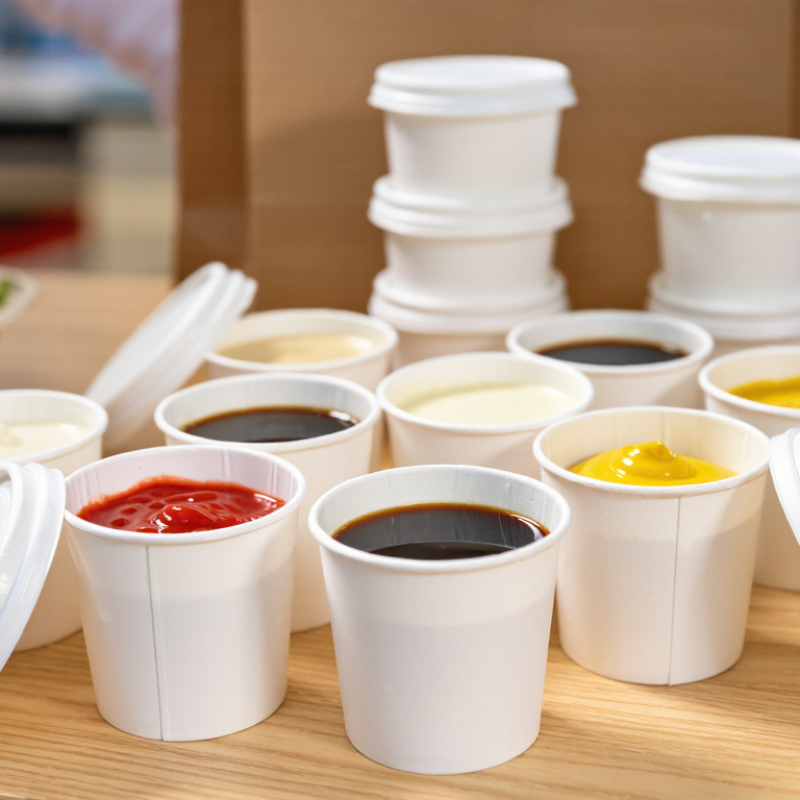
Paper sauce cups are small, molded containers made from food-contact paperboard. Their structure usually combines a shaped fiber body with a thin moisture barrier. This barrier may use dispersion coatings, biopolymer layers, or other approved materials. The lid needs a firm rim, because a loose fit can cause leaks during delivery. The cup also requires enough stiffness for sauces, dips, and dressings without collapsing in the hand.

Design starts with the sauce, not only the material. Oil-based products may need stronger resistance than watery condiments. Hot fillings can also soften poorly selected coatings. According to FAO’s 2023 forest-products statistics, global paper and paperboard production reached about 417 million tonnes in 2022. This scale supports paper packaging supply, but it does not make every paper cup automatically sustainable. That assumption needs checking.

A practical design often uses a rolled edge, tapered walls, and a measured fill line. These details reduce spills and improve stacking efficiency. The McKinsey report Sustainability in Packaging: Global Consumer Views found that 60% to 70% of surveyed consumers were willing to pay more for sustainable packaging. Still, consumers may reject cups that leak or feel weak. A paper sauce cup can be renewable in appearance, yet difficult to recycle when coatings and food residue remain attached. Design teams should test barrier performance, compression strength, sealing, and end-of-life pathways before making environmental claims. Small failures matter.

Why Choose Paper Sauce Cups for Global Food Packaging?

Paper sauce cups are small paperboard containers designed for condiments, dips, dressings, and toppings. Their rolled rim improves rigidity, while a food-safe barrier coating helps resist moisture and grease. Common nominal sizes range from 1 to 4 US fluid ounces, supporting portion control across takeaway, catering, and food-service applications.

The chart shows common nominal paper sauce cup capacities. Values are converted from US fluid ounces using 1 US fl oz = 29.5735 mL.

Why Do Paper Sauce Cups Suit Global Food Packaging Needs?

Paper sauce cups suit global food packaging needs because they balance portability, portion control, and practical presentation. Their light weight reduces handling effort during delivery and takeaway service. A 30-milliliter cup can hold dipping sauce, dressing, or condiments beside a meal. Small portions help kitchens maintain consistent serving sizes across different locations.

The paper structure also supports efficient storage. Stacked cups occupy less space than many rigid containers. With a suitable food-contact coating, they can resist oil, moisture, and short-term heat. Still, performance depends on the coating, folding quality, and filling temperature. Paper is not automatically leakproof. Testing matters. Drop tests, seal checks, and several hours of refrigerated storage can reveal weak points before distribution.

Global packaging requires more than attractive appearance. Suppliers should provide material specifications, food-contact documentation, and clear recycling guidance for each market. Local waste systems differ widely, so a recyclable design may not be recyclable everywhere. Printing can communicate portion information and handling instructions without adding unnecessary packaging. In real operations, condensation, rough transport, and rushed staff can expose small design flaws. A reliable paper sauce cup should remain stable on a tray, open cleanly, and avoid soaking through during normal use. Some failures are useful reminders: sustainability claims need evidence, not just green-looking paper.

How Are Paper Sauce Cups Made and Customized?

Paper sauce cups begin with food-grade paperboard selected for stiffness, printability, and safe contact with sauces. The material is coated with a moisture barrier, often using polyethylene or a water-based dispersion. The correct choice depends on heat, oil, acidity, and disposal requirements. It is not one solution for every recipe.

Manufacturing starts with printing large paper sheets. Designs are checked for color accuracy and readable nutrition information. Die-cutting then creates precise cup blanks. Forming machines bend each blank into a round container and seal the side seam. The base is pressed into place and tightly curled around the lower edge. Operators inspect the rim, seam, and bottom. Small flaws matter.

Customization involves more than adding a logo. Buyers can choose capacity, diameter, wall height, rim shape, coating type, and lid compatibility. A 30-milliliter cup may suit dipping sauce, while a deeper shape works better for thicker dressings. Printing can cover the outside with simple colors or detailed patterns. However, heavy ink coverage may affect drying and production speed. Samples should face leak tests, stacking checks, and temperature trials before approval. We have found that a cup can look excellent yet soften during refrigerated storage. That result deserves a design change, not an excuse. Local packaging rules and compostability claims also require careful verification.

What Environmental Benefits Do Paper Sauce Cups Offer?

Why Choose Paper Sauce Cups for Global Food Packaging?

Paper sauce cups can reduce fossil-based material use when their fiber content replaces conventional plastic. The benefit begins with the raw material. The Confederation of European Paper Industries reported an 82.5% paper recycling rate in Europe in 2023, showing a mature recovery system. However, this figure covers paper products broadly, not every sauce cup.

That distinction matters. Many cups use a thin plastic lining for grease and moisture resistance. Food residue can also prevent sorting facilities from accepting them. The U.S. Environmental Protection Agency reported a 68.2% recycling rate for paper and paperboard materials in 2018, but small, contaminated food-service items may perform worse. Real-world results depend on local collection rules and cup design.

Still, paper sauce cups offer practical environmental advantages. Their renewable fiber content can support lower reliance on virgin plastic. Responsible forestry standards may also improve traceability. The OECD’s Global Plastics Outlook found that only 9% of global plastic waste was recycled in 2019. That comparison is useful, but not conclusive.

Paper is not automatically greener.

A well-designed cup should use minimal material, avoid unnecessary coatings, and clearly identify disposal routes. Recyclability claims need testing, not hopeful wording. In a busy takeaway kitchen, a clean paper cup with a secure lid can also reduce leaks and food waste. Yet transport distance, manufacturing energy, and end-of-life access still shape the final impact.

Why Choose Paper Sauce Cups for Global Food Packaging? - What Environmental Benefits Do Paper Sauce Cups Offer?

Evidence-based environmental profile of paper sauce cups compared with conventional fossil-based plastic alternatives

Environmental Dimension Typical Paper Sauce Cup Data Potential Environmental Benefit Important Consideration
Primary raw material Mainly cellulose fiber from wood or recycled paper sources; the exact fiber mix depends on the product specification. Uses a renewable, plant-based feedstock instead of relying entirely on finite fossil resources. Responsible forestry certification, recycled fiber content, and supplier traceability influence the overall benefit.
Renewable material potential The paperboard body can contain a high proportion of renewable fiber; barrier coatings may be made from plastic, dispersion coatings, or bio-based materials. A fiber-based structure can reduce dependence on virgin fossil-based polymers in food-service packaging. “Paper” does not automatically mean plastic-free or fully bio-based. The complete cup construction must be assessed.
Recyclability Uncontaminated paper and board are widely accepted in established paper-recycling systems. Food and sauce residues can reduce acceptance and fiber quality. Recovered paper fibers can be used to manufacture new paper and board products, helping reduce demand for virgin fiber. Recyclability depends on local collection rules, coating type, cup design, sorting technology, and the level of food contamination.
Industrial compostability A certified compostable paper sauce cup should meet applicable requirements such as EN 13432, including approximately 90% biodegradation within 180 days and disintegration within 12 weeks under controlled test conditions. Where industrial composting is available, certified products can be treated with suitable organic waste streams. Industrial compostability is not the same as home compostability or natural litter decomposition. Local facilities and accepted-item policies are essential.
Biodegradation in the environment Paper fibers generally biodegrade more readily than conventional polyethylene or polypropylene, but coatings, inks, adhesives, and additives affect the result. Fiber-based components have lower persistence potential than many conventional plastic components when managed under suitable biological conditions. No food-service package should be littered. Moisture, temperature, oxygen, coating chemistry, and microbial activity determine degradation speed.
Fossil-plastic reduction Replacing a conventional all-plastic sauce container with a fiber-based cup can reduce the amount of fossil-derived plastic used, especially when the barrier is thin or non-plastic. May reduce demand for virgin fossil polymers and decrease the quantity of persistent plastic packaging entering waste systems. A plastic-lined paper cup still contains plastic. The packaging specification should state the coating material and its percentage by weight.
Material efficiency Paperboard can be converted into lightweight, nestable cups with a defined volume, commonly used for single-serve sauces and condiments. Efficient nesting can reduce storage space and the number of transport units required per shipment. Actual transport savings depend on cup dimensions, wall thickness, case design, fill volume, and shipping distance.
Transport and storage Nested empty cups generally occupy less space than assembled rigid containers of the same capacity. Higher units per carton or pallet can improve logistics efficiency and potentially reduce transport-related emissions per cup. A complete life-cycle assessment is required to quantify emissions because production energy, transport mode, and end-of-life treatment vary by region.
Water and moisture resistance Food-contact paper cups require a barrier layer or treatment to contain liquid sauces. Common options include polyethylene, polypropylene, aqueous dispersions, or other coatings. A suitable barrier prevents leakage and food waste, which can be environmentally significant because wasted food carries the impacts of its production. Barrier performance must be balanced with recyclability and compostability. A stronger barrier is not automatically a better end-of-life option.
Food-contact safety Paperboard and coatings should comply with the food-contact requirements of the destination market, including limits for migration and restricted substances. Safe packaging supports hygienic portion control and reduces contamination-related food waste in food-service operations. Compliance must be verified for the actual paperboard, coating, ink, adhesive, sauce type, temperature, and contact duration.
Chemical management Fluorinated grease-resistant chemicals, commonly referred to as PFAS, should be avoided or controlled according to applicable regulations and customer requirements. PFAS-free designs can reduce concerns related to persistent chemicals in manufacturing, recycling, composting, and waste management. “Paper-based” does not by itself confirm PFAS-free status. Obtain a current material declaration or laboratory test report.
End-of-life priority
  • Reuse where hygienically permitted
  • Recycle when accepted and sufficiently clean
  • Industrially compost only when certified and locally supported
  • Dispose as residual waste when other routes are unavailable
Designing for the actual local waste infrastructure can improve recovery rates and prevent avoidable contamination. The best disposal route differs by country, municipality, facility, coating, and contamination level.
Data basis: General packaging and environmental principles referenced by widely used standards and guidance, including EN 13432 for industrially compostable packaging, ISO 14040 and ISO 14044 for life-cycle assessment, and recognized paper-recycling and food-contact compliance frameworks. Actual environmental performance must be verified for the complete product specification and destination market.

Note: Environmental benefits are influenced by fiber sourcing, coating composition, manufacturing energy, transportation, consumer behavior, collection systems, and local recycling or composting infrastructure.

What Factors Should Buyers Consider Before Choosing Them?

When buyers evaluate paper sauce cups, material performance should lead the discussion. A cup may look sturdy on a sample table, yet soften after ten minutes with hot curry. Check paperboard weight, inner coating, seam strength, and resistance to oil, salt, and acidity. Ask suppliers for food-contact, migration, and quality test documents relevant to the destination market.

Testing matters more than attractive product photos. Fill samples with the actual sauce, close them with the intended lids, and carry them in a delivery bag. Small leaks become expensive complaints. Very small details matter.

Capacity and shape also affect real operations. A 2-ounce cup suits a tasting portion but may frustrate customers needing extra dressing. Confirm rim diameter, lid fit, stack height, and compatibility with automated filling equipment. Measure the cup beside existing trays.

Poor nesting can waste storage space and slow packing. Buyers should compare minimum order quantities, lead times, carton dimensions, and replacement policies. A cheaper cup is not cheaper if shipments arrive late or cartons collapse in humid warehouses. That happens.

Sustainability claims require careful questions. Paper content, coating type, printing inks, and local recovery systems all influence disposal options. Terms such as “compostable” or “recyclable” should have clear test standards and regional acceptance behind them.

Some paper cups perform well in dry service but fail under oily sauces. That limitation deserves honest attention. Request production samples from different batches, inspect odor and surface consistency, and record leakage results. Supplier experience with similar sauces is useful, but your own trial remains essential.